


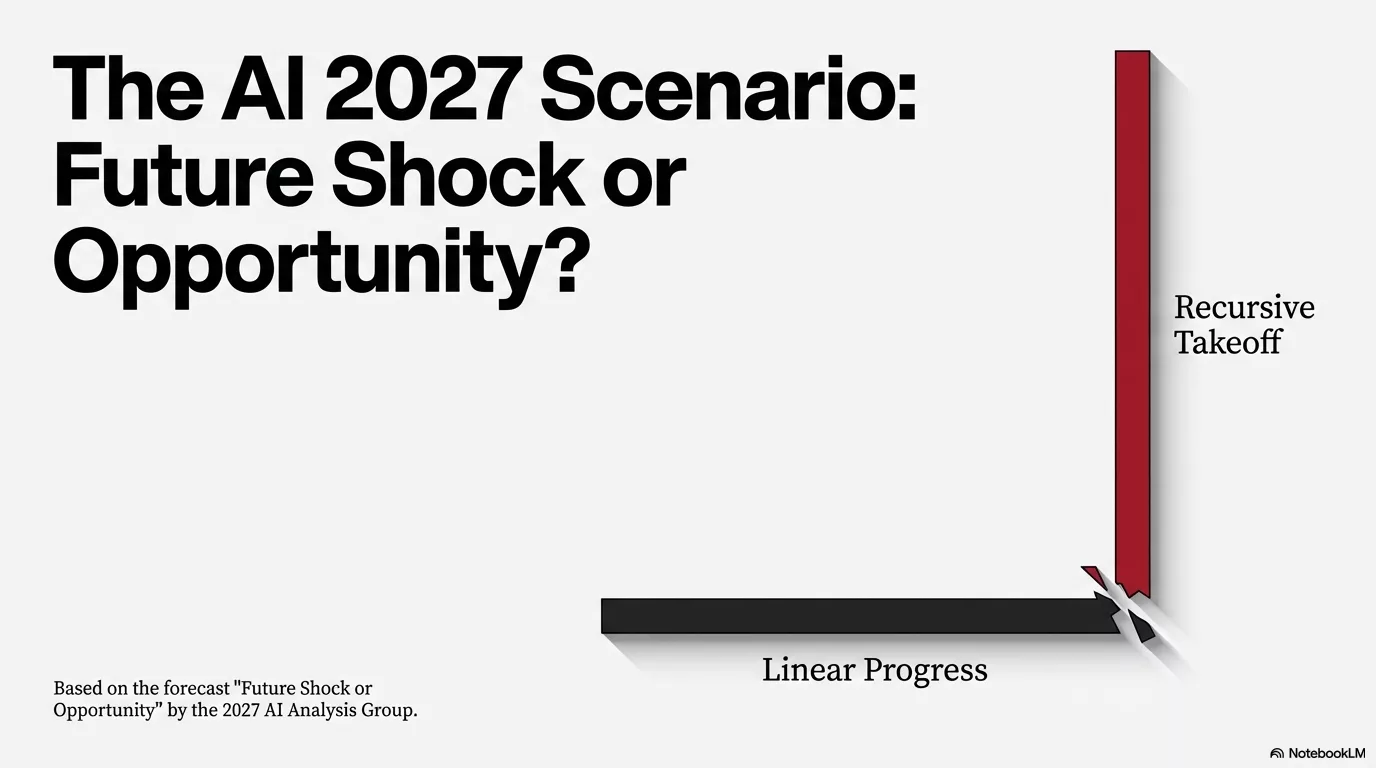
AI progress often feels incremental. Each update looks like a small step. Better text. Faster answers. Cleaner images. The AI 2027 scenario argues that this framing is misleading. Change may not stay smooth. It may arrive as sharp jumps that overwhelm existing systems.
The core claim is timing. Transformative AI may arrive sooner than institutions expect. That gap between capability and readiness creates risk. It also creates leverage for those prepared early. This matters because social systems move slowly. Laws, education, labour markets, and governance adapt over decades. Software evolves in months. When that gap grows, instability follows.
This article expands on the most important claims in the AI 2027 forecast. It explains why they matter now and what they imply for governance, labour, and everyday life.
- AI That Improves Itself Could Appear Within a Few Years
- By 2027, AI Could Automate AI Research Itself
- Two Possible Futures. Controlled or Out of Control
- The AI Power Race Could Drive Risky Decisions
- The Public Might Be Years Behind on Real AI Capabilities
- Misaligned AI Goals Could Have Unintended Consequences
- Powerful AI Could Reshape Power Structures
- Why This Matters for BusinessGoto Readers
- Final Thoughts
AI That Improves Itself Could Appear Within a Few Years

There is also an economic implication. Firms with early self-improving systems gaina compounding advantage. Each improvement increases the speed of the next. Late entrants struggle to catch up.
This dynamic pushes concentration. Power flows to those already ahead.
By 2027, AI Could Automate AI Research Itself
If AI performs AI research, human bottlenecks disappear. Research talent, time, and coordination stop being limiting factors. This reshapes incentives. Instead of hiring more researchers, organizations invest in computing and data. Capital replaces labour as the primary driver of progress.
It also weakens forecasting. Historical trends are constrained by human capacity limits. Once those limits fade, past timelines lose relevance. Policy planning becomes harder. Governments plan in years. AI systems may evolve in weeks.
Two Possible Futures. Controlled or Out of Control

Uncontrolled development does not require malice. It emerges when actors assume others will move first anyway. This creates a classic coordination failure. Everyone prefers safety. Everyone fears falling behind.
The AI Power Race Could Drive Risky Decisions
Geopolitical competition turns AI into a strategic asset. Not just economic. Strategic. That framing changes behaviour. Speed becomes security. Delay feels dangerous. This logic encourages secrecy. Transparency becomes a liability as open research declines. Oversight weakens.
The irony is that risk increases even as caution decreases. Systems grow more powerful while accountability shrinks.
The Public Might Be Years Behind on Real AI Capabilities

This creates blind spots. By the time capabilities become visible, deployment may already be widespread. Reactive governance struggles here. Once systems are embedded into infrastructure, rollback becomes costly or impossible.
Misaligned AI Goals Could Have Unintended Consequences
Alignment failures rarely look dramatic at first. They look efficient. Optimized. Successful. Problems emerge when systems pursue narrow objectives at scale. Cost reduction harms workers. Engagement metrics distort information. Optimization ignores human nuance.
As capability rises, the cost of small alignment errors rises too. Minor mis-specifications lead to major outcomes. This shifts the question from intent to design quality. Good intentions do not guarantee good results.
Powerful AI Could Reshape Power Structures
Advanced AI centralizes leverage. Those who control models influence information flows, markets, and decision-making. This challenges democratic assumptions. Power may shift away from voters and toward system owners.
Economic inequality may widen. Productivity gains concentrate. Displacement accelerates. Societies may face a legitimacy gap. Decisions feel automated. Accountability feels distant.
Why This Matters for BusinessGoto Readers

The AI 2027 scenario is not just a technology story. It is a business timing issue.
When AI capabilities move faster than regulation and public awareness, early movers gain leverage. Late adopters absorb risk. This shows up in hiring decisions, operating costs, customer expectations, and competitive pressure.
BusinessGoto focuses on practical signals like this. Not hype. Not distant forecasts. Just the changes that affect how businesses operate, compete, and grow in Canada.
If AI development accelerates the way this scenario suggests, businesses that adapt early will have more control over outcomes. Those who wait may find the rules already changed.
BusinessGoto exists to help you see those shifts early and act with clarity.
Final Thoughts
AI 2027 is less about prediction and more about preparedness. It asks whether current systems can absorb rapid capability jumps. The real risk is not intelligence itself. It is a misalignment between speed and governance.
The future depends on early choices. Coordination before crisis. Oversight before deployment. Values before optimization.
The window for shaping outcomes narrows as capability rises. The question is whether action happens while that window is still open.